Extra Practice for Exam 2
Please Log In for full access to the web site.
Note that this link will take you to an external site (https://shimmer.mit.edu) to authenticate, and then you will be redirected back to this page.
Below are some additional questions that our TAs have written/collected for you to study. These are entirely optional; we do not record your scores, and these do not factor into your final grade.
These questions were chosen based on their relevance to topics we've covered so far. However, they should not be taken as representive of the types of questions on our exam, whether in format, difficulty, or coverage.
Question 1.
Implement the function that meets the specification below. For example, when def reverse_graph(g):
"""
Create a reversed directed graph from a given directed graph.
If node u points to node v in the original graph, node v should
point to node u in the returned graph.
Parameters:
g (dict): A mapping from starting nodes (str) to lists of
neighboring nodes.
Return a dict representing the reversed graph, in the same form as
g. It should only include as keys nodes that have at least one
outgoing edge in the reversed structure. Each list of neighbors
should be sorted lexicographically.
"""
g = {"A": ["B", "D"], "B": ["C", "D"]}, reverse_graph(g) should evaluate to:{
"B": ["A"],
"C": ["B"],
"D": ["A", "B"],
}

For example, when Hint: Consider a DFS-style traversal of the nested lists.def flatten(seq):
"""
Extract all the non-list objects within a structure of nested lists
to arbitrary depth.
Parameters:
seq (list): A sequence of elements, some of which may be lists,
or lists containing other lists, etc.
Return a new list that contains all the non-list objects in the
order they would appear if seq were printed.
"""
L = [ [1, 4, [6], 2], [ [[3]], 2 ], 4, 5 ], flatten(L) should return:[1, 4, 6, 2, 3, 2, 4, 5]
Which of the following statements are true?
Select all that apply.[1.2, 10.5].
Question 6.
Consider the following weighted, undirected graph. What is the order of nodes visited by both BFS and DFS starting from A?
You can assume that the neighbors of each node are explored in alphabetical order. Provide your answer as a dictionary where the keys are Example format: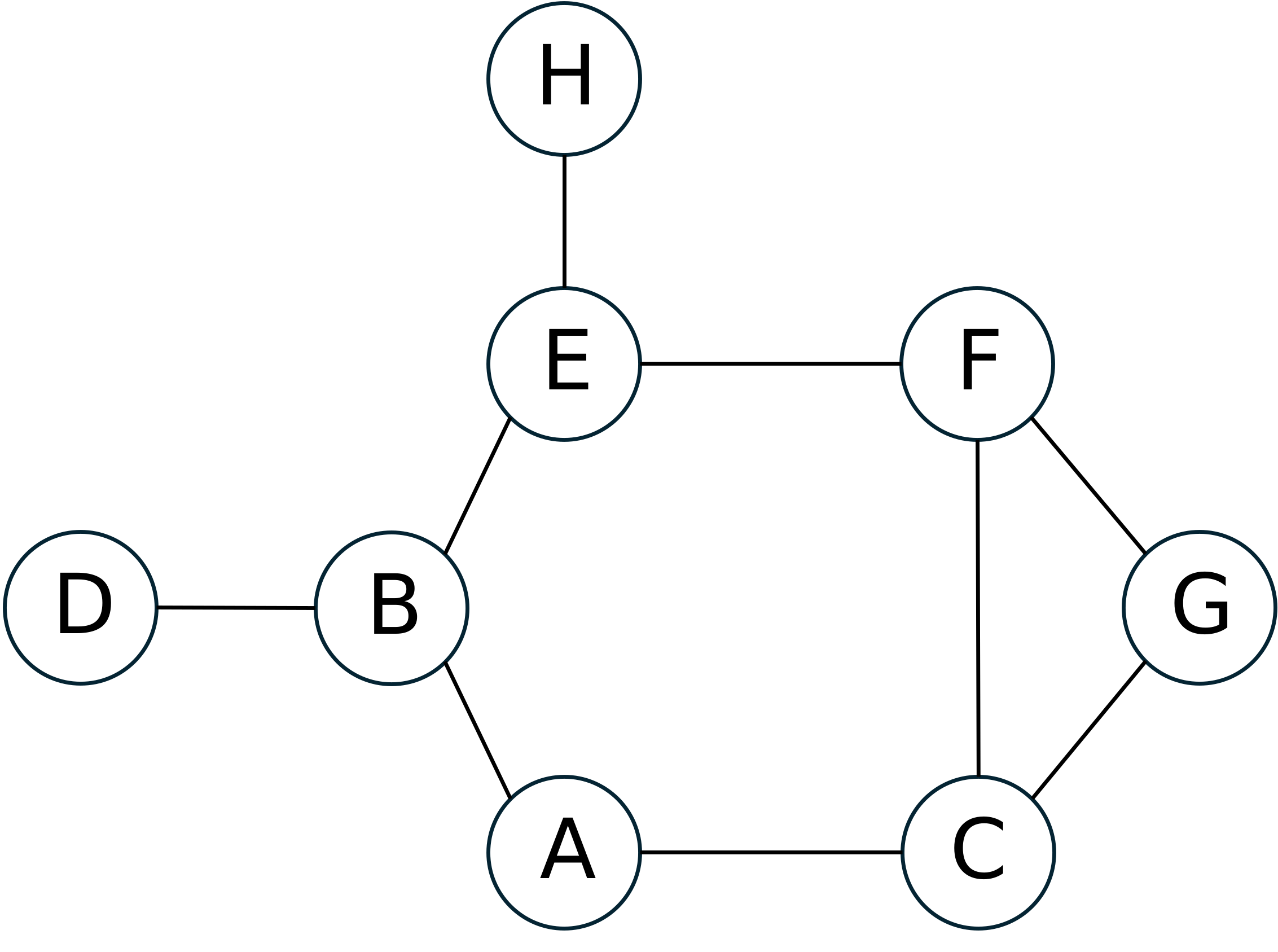
"dfs" and "bfs", and each value is a list of strings.
Include the starting node A.{
"dfs": ["A", ...],
"bfs": ["A", ...],
}
You can move up, down, left, or right, and you wish to find a route that requires the minimum effort.
A route's effort is the maximum absolute difference in altitudes between any two consecutive cells of the route. Find the minimum effort and the path required to travel from the top-left cell to the bottom-right cell.
For example: This problem can be solved by adapting Dijkstra's algorithm.
To do so, we've provided in the submission box most of the code for the You may assume the Hint 1:
In this problem, grid cells can be thought of as nodes in a graph, where edges connect neighboring cells.
What is the weight of an edge in this graph? Hint 2:
In lecture, the cost of a path was the sum of all the weights of the edges in that path.
What is the cost of a path in this problem?grid as list of rows lists, each of length columns, where grid[row][col] represents the altitude of cell (row, col) in a 2D grid.
You are situated in the top-left cell, (0, 0), and you hope to travel to the bottom-right cell, (rows-1, columns-1).
grid = [ [1, 2, 2], [3, 8, 2], [5, 3, 5] ]2, [1, 3, 5, 3, 5][1, 3, 5, 3, 5] (highlighted in green) has a maximum absolute difference of 2 across consecutive cells.
This is better than the route [1, 2, 2, 2, 5], where the maximum absolute difference is 3.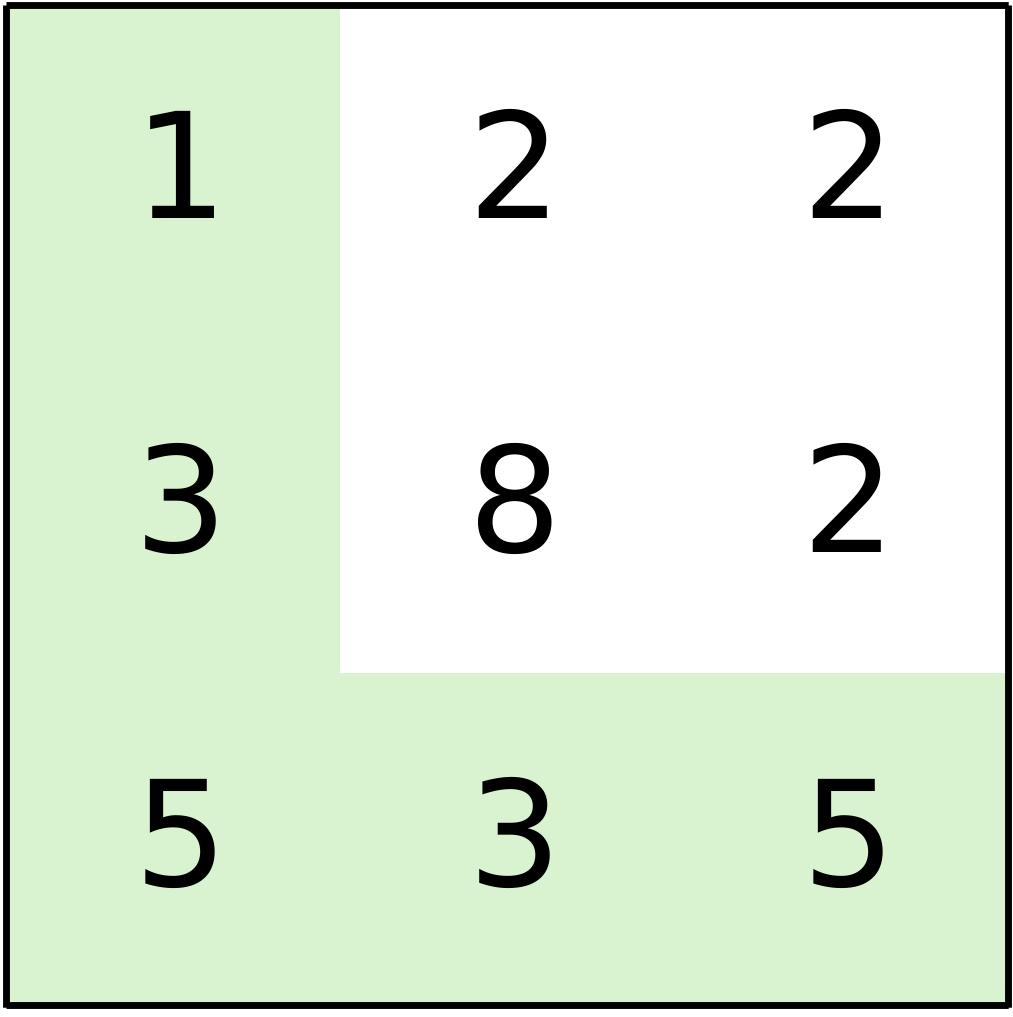
neighbors() and minimum_effort_path() functions.
Complete the lines marked # TODO, so these functions satisfy their specifications below.remove_min(), find_node(), and update_node() functions from lecture are available.def neighbors(grid, cell):
"""
Retrieve the neighbors of a cell location within grid. Valid
neighbors of a given cell are the cells to the top, down, left, and
right that are within bounds.
Parameters:
grid (list): A list of lists of ints, representing a 2D grid,
and grid[i][j] is the altitude at cell location (i, j).
cell (tuple): An (i, j) index location within the grid.
Return a list of (neighbor, weight) tuples, where neighbor is an
(i, j) tuple, and weight is the effort of traversing from cell to
neighbor.
"""
def minimum_effort_path(grid):
"""
Given a grid (as described above), return the minimum effort
required to travel from the top-left cell to the bottom-right cell.
"""